
Sattva Varthur Road vs Sattva Whitefield: The 2026 Value Test
Both of these projects sit on the same balance sheet: Sattva Group, CRISIL AA/Stable rated, 142+ projects and 69 million-plus sq ft delivered since 1993. Both are pre-launch, and both are still waiting on K-RERA registration. Developer risk therefore cancels out of the equation entirely, and what remains is a clean set of trade-offs. Sattva Varthur Road opens a ~16-acre, 1,363-apartment community at Dommasandra Circle from roughly ₹67 lakh at EOI-stage rates; Sattva Whitefield asks about ₹1.30 crore to enter a 25-acre campus sitting 2–3 km from ITPB with an operational metro line a short drive away.
This guide runs the numbers a Varthur Road buyer should work through before either dismissing the Whitefield alternative or paying its premium: rupees per square foot, commute minutes, configuration fit, density, delivery calendar and the exit case.
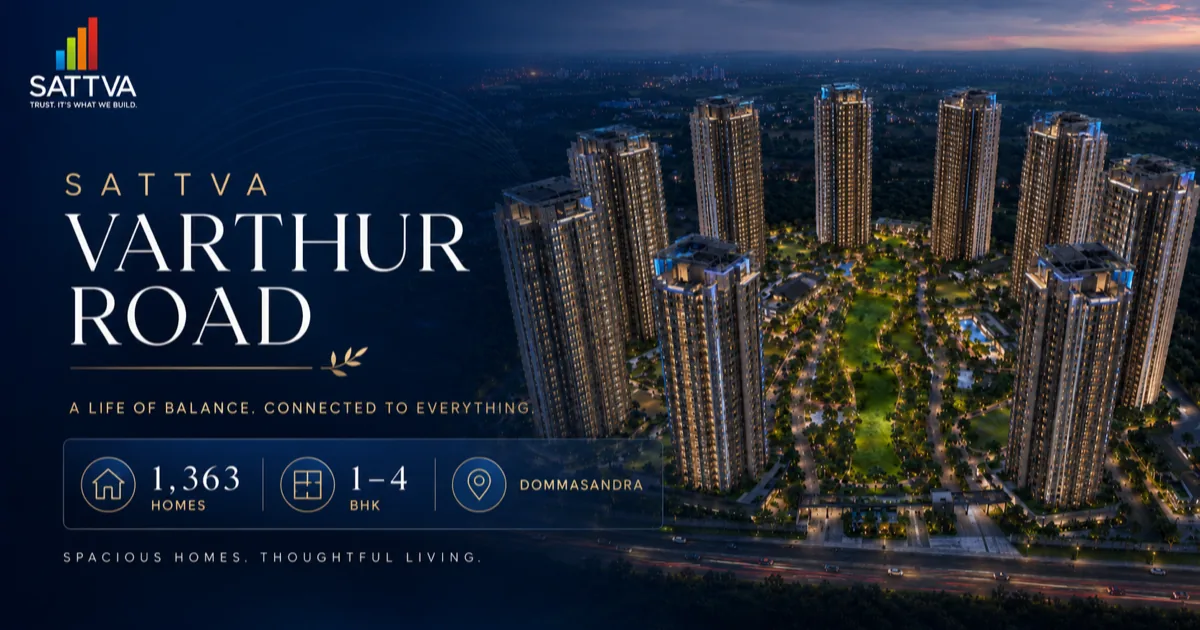
At a glance: Sattva Varthur Road vs Sattva Whitefield
| Factor | Sattva Varthur Road | Sattva Whitefield |
|---|---|---|
| Guidance rate (₹/sq ft) | EOI ₹11,200; launch guidance ₹12,300 (recorded Jul 2026; channels still quote On Request) | Estimated ₹11,000–13,500 pre-launch; official sheet at launch |
| Entry ticket | ~₹67 lakh — 1 BHK, 600 sq ft at EOI-stage rate (indicative) | ~₹1.30 Cr — 2 BHK, 1,100 sq ft (estimated) |
| Top ticket | ~₹2.8 Cr — 4 BHK + servant, up to 2,310 sq ft (EOI-rate derived) | ~₹2.50 Cr — 3 BHK, up to 1,800 sq ft (estimated) |
| Configurations | 1, 2, 3 (2-toilet and 3-toilet) and 4 BHK — 600–2,310 sq ft | 2 & 3 BHK only — 1,100–1,800 sq ft |
| Land area | ~16 acres | 25 acres |
| Units & towers | 1,363 apartments; 8 towers, 3B + G + 33 floors | ~2,000 apartments; tower count not announced |
| Density | ~85 units per acre; three-level basement parking | ~80 units per acre; 70%+ open space stated |
| Possession | March 2031 target; launch Q3 2026 | December 2029 estimated; phased delivery typical |
| RERA status | Not yet registered; BDA-approved layout | Registration awaited (pre-launch) |
| Developer | Sattva Group — CRISIL AA/Stable, 142+ projects, 69M+ sq ft | Same developer, same rating |
| Micro-location | Dommasandra Circle, SH-35 Varthur–Sarjapur Road, 560087 | Whitefield core, 560066; ITPB 2–3 km |
| Metro reality | Proposed Phase 3A Red Line; commissioning est. 2030–33 | Purple Line operational — Whitefield (Kadugodi) station 3–4 km |
The entry-price gap: ₹67 lakh against ₹1.30 crore
Public channels still list Sattva Varthur Road at "price on request", but EOI-stage guidance recorded in July 2026 stands at ₹11,200 per sq ft, with launch guidance of ₹12,300 — a step up from the earlier indicative band of ₹10,300–11,500 all-inclusive. Until the official rate card is published at launch, every figure here is indicative. At EOI-stage rates the 600 sq ft 1 BHK computes to roughly ₹67 lakh, the 1,080–1,210 sq ft 2 BHKs to about ₹1.21–1.36 crore, the 3 BHK stock from approximately ₹1.47 crore, and the largest 4 BHK-plus-servant homes of 2,310 sq ft to around ₹2.8 crore.
Sattva Whitefield carries an estimated pre-launch band of ₹11,000–13,500 per sq ft: 2 BHKs of 1,100–1,300 sq ft at roughly ₹1.30–1.75 crore and 3 BHKs of 1,500–1,800 sq ft at ₹1.80–2.50 crore, with the configuration-wise breakdown on the Sattva Whitefield price page. Its official cost sheet is likewise pending formal launch.
Put the two bands side by side and the honest finding is this: on rate, the projects overlap heavily. The roughly ₹63 lakh gap in entry tickets is a function of unit size, not of one project being intrinsically cheaper — Whitefield simply has no home smaller than 1,100 sq ft, while Varthur Road starts at 600. A buyer with ₹1.5 crore to deploy is choosing between near-identical per-square-foot economics; a buyer with ₹70–90 lakh has exactly one of these two doors open.
Commute math: Dommasandra Circle vs the Whitefield core
Sattva Varthur Road fronts SH-35, the Varthur–Sarjapur Road, at Dommasandra Circle — behind Greenwood High School, pincode 560087. Wipro's Kodathi campus is about 5 km away, the Outer Ring Road at Bellandur roughly 10 km, ITPL and central Whitefield about 12 km via Varthur, and Kempegowda International Airport around 50 km — a 75–90 minute run via the ORR–Hebbal route.
Sattva Whitefield inverts that geometry. It sits inside the established Whitefield district (560066): ITPB — Bengaluru's largest tech park — is 2–3 km out, the Outer Ring Road 4–5 km, the airport about 42 km, and, decisively, the Whitefield (Kadugodi) Purple Line metro station is 3–4 km away and running today, connecting to MG Road and Majestic in about 45 minutes. The anchors and distances are mapped on the Sattva Whitefield location page.
The metro asymmetry deserves precision. Varthur Road's rail story is Metro Phase 3A — the proposed Hebbal–Sarjapur Red Line, 36.59 km and 28 stations, whose revised October 2025 DPR cut the project cost to ₹28,405 crore. It still awaits Union Cabinet approval (expected by end-2026), with construction likely through 2027–28 and commissioning phased across 2030–2033. That window roughly matches the project's own March 2031 completion target, which makes it genuine medium-term upside — but it is not a train you can board during your loan's early years. If your household runs on daily rail transit, Whitefield wins this dimension outright today; if you drive to the Sarjapur–ORR employment belt, Dommasandra's position near Kodathi is the shorter commute.
Configuration fit: a five-rung ladder against a two-format campus
Sattva Varthur Road fields the widest affordability spread in its immediate micro-market — five distinct rungs: a 600 sq ft 1 BHK; 2 BHKs of 1,080–1,210 sq ft; a two-toilet 3 BHK at 1,310–1,420 sq ft; a three-toilet 3 BHK at 1,532–1,800 sq ft; and 4 BHK-plus-servant homes of 2,040–2,310 sq ft with three balconies. Eight towers rise to three basements plus ground plus 33 floors.
Sattva Whitefield runs a deliberately narrower book: 2 BHKs of 1,100–1,300 sq ft (carpet 770–910 sq ft) and 3 BHKs of 1,500–1,800 sq ft (carpet 1,050–1,260 sq ft), all planned as Vaastu-compliant with cross-ventilation and balcony access. The layout detail sits on the Sattva Whitefield floor plans page.
What the ladder means in practice:
- First-time buyers and investors under ₹1 crore have a genuine option only at Varthur Road — the 1 BHK tier simply does not exist at Whitefield.
- Mid-family 3 BHK buyers can pick either; note that Varthur Road splits its 3 BHK into two-toilet and three-toilet variants, creating a stepping stone from roughly ₹1.47 crore below the full-size format.
- Large-format buyers wanting a servant's room and 2,000-plus sq ft again have only one door: Varthur Road's 4 BHK. Whitefield tops out at 1,800 sq ft.
- Buyers who prize homogeneity — a residents' mix of families in 2–3 BHKs, without a studio-investor tier — will prefer Whitefield's narrower band and the steadier tenancy profile it implies.
Density, open space and what each campus feels like
Numerically the two are closer than their acreage suggests. Sattva Varthur Road places 1,363 apartments on ~16 acres — about 85 units per acre — by going vertical: eight towers of 33 upper floors over three basement parking levels, freeing the ground plane for a clubhouse-anchored central amenity deck and landscaped green. Sattva Whitefield spreads ~2,000 apartments across 25 acres — about 80 units per acre — and commits to 70%-plus open and green space with a 20,000-plus sq ft clubhouse; its tower count and floor heights are not yet announced.
The amenity programmes rhyme, as you would expect from a single developer: both plan large pools (Whitefield's is temperature-controlled), tennis and badminton courts, indoor games rooms, mini theatres, libraries, amphitheatres, pet zones, senior-citizen corners, jogging and cycling tracks, rainwater harvesting, sewage-treatment recycling, solar-lit common areas and EV charging. Varthur Road's published list currently runs longer — squash court, spa, steam and sauna, salon, creche, co-working lounge, reflexology pathway, organic waste converter, dual plumbing and app-based visitor management — but Whitefield's sheet is earlier-stage and will likely grow toward parity by launch.
The real difference is scale-feel. A 25-acre parcel with a stated 70% open-space ratio buys longer sight-lines and wider tower spacing than a 16-acre vertical scheme can manage, even at similar per-acre density. Against that, Varthur Road's three-basement parking discipline keeps cars off the surface entirely — a specification Whitefield has not yet published — and its single central green gives the compact site one big shared heart rather than distributed pockets.
Timeline and paperwork: two pre-RERA bets, fifteen months apart
Neither project can quote a K-RERA number today. Sattva Varthur Road is not yet registered; the layout itself is BDA-approved. Sattva Whitefield's registration is awaited, expected at or before its formal launch. In both cases the non-negotiable buyer discipline is identical: verify the registration on rera.karnataka.gov.in before signing anything, and treat any RERA number circulating for either project before launch as unverified.
Sattva's recent operating cadence softens the wait. The group's newest Bengaluru launch received its registration essentially at launch — registration one day, sales opening immediately after — so an EOI stage without a registration is the group's standard sequencing rather than a red flag specific to either of these projects. The group also signalled IPO readiness in December 2025 and guided four to five residential launches for the coming year, which argues for process maturity on both sites.
The calendar gap is the harder differentiator. Sattva Whitefield's estimated possession is December 2029, with phased delivery across 2028–2030 typical for a ~2,000-unit campus. Sattva Varthur Road launches in Q3 2026 and targets completion in March 2031 — roughly fifteen months later. For an end-user paying rent, fifteen months of Bengaluru eastern-belt rent is a real number that claws back part of Varthur Road's cheaper ticket; for a landlord, later delivery pushes the income start equally far out. Both dates are pre-RERA estimates and only harden once each registration is issued — re-check them against the certificates when they publish.
The appreciation case: corridor beta against established depth
Sattva Varthur Road's investment argument is corridor momentum. Varthur Road flats average about ₹10,900 per sq ft (range ₹8,550–12,800) with 81.7% appreciation over three years and 175.9% over ten — among East Bengaluru's steepest sustained climbs. One node over, Sarjapur Road's core averaged around ₹12,000 per sq ft in Q1 2026, up 15.7% in a year and 84.1% over three. Dommasandra and Kodathi remain the corridor's entry-price pockets at ₹10,500–11,500, and nearby Gunjur logged a 231.8% ten-year run. The thesis is simple: buy the emerging node before the corridor's core pricing migrates outward — with Metro Phase 3A's estimated 2030–2033 commissioning window landing almost exactly on the project's March 2031 completion.
Sattva Whitefield's case is depth rather than beta. Whitefield values are up about 35% over five years with rental vacancy below 5% — an established market where ITPB, the EPIP Zone and twenty-plus tech parks generate tenant demand today, on nobody's approval timeline. That profile suits a buyer who wants rental income from possession day and lower variance in exit pricing.
Two honest caveats. First, all Varthur Road pricing is EOI-stage and the project is unregistered; the corridor statistics describe the market around the project, not the project itself. Second, established-market depth cuts both ways — Whitefield's five-year 35% is steady but well below the Varthur corridor's three-year 81.7%, and no market repeats its past curve on schedule. Size the bet to your horizon: a pre-2030 exit favours the established address; a 2031-plus horizon gives the emerging corridor's catalysts time to mature.
Verdict: which buyer books which
The clean split, dimension by dimension:
- Budget under ₹1 crore: Sattva Varthur Road, by default — its 600 sq ft 1 BHK at roughly ₹67 lakh has no Whitefield counterpart.
- Daily metro commuter or ITPB/Whitefield workplace: Sattva Whitefield. An operational Purple Line station 3–4 km away beats a proposed 2030–2033 line every working morning.
- Sarjapur–ORR–Kodathi workplace: Sattva Varthur Road — Wipro Kodathi at about 5 km is the shorter drive.
- 4 BHK or servant-room requirement: Varthur Road only; Whitefield tops out at an 1,800 sq ft 3 BHK.
- Earliest keys: Whitefield — December 2029 estimated against March 2031 targeted.
- Appreciation-first investor with a 2031-plus horizon: Varthur Road's Dommasandra entry pricing rides the corridor's trend lines and the Phase 3A catalyst.
- Rental income from day one: Whitefield's sub-5% vacancy market is the safer landlord's bet.
If this comparison has moved you toward the bigger campus, start with the Sattva Whitefield project overview and pressure-test its estimated band against your own configuration shortlist. Whichever way you lean, the same rule binds both sides: neither project is RERA-registered yet, so anchor your booking decision to the registration number verified on the Karnataka RERA portal — not to a brochure, and not to this page.
Comparing Sattva Varthur Road and Sattva Whitefield? Talk to us.
Our team can share dated cost sheets, current offers and a side-by-side breakdown for both projects so you can decide with real numbers. Most responses arrive within the hour during business hours.
Talk to a Sales ConsultantSattva Varthur Road vs Sattva Whitefield - Frequently Asked Questions
Which is cheaper, Sattva Varthur Road or Sattva Whitefield?
At entry-ticket level, Sattva Varthur Road — its 600 sq ft 1 BHK computes to roughly ₹67 lakh at EOI-stage rates, against Sattva Whitefield's estimated ₹1.30 crore starting 2 BHK. On rate, they overlap: about ₹11,200–12,300 per sq ft guidance at Varthur Road versus an estimated ₹11,000–13,500 at Whitefield. Both figures are indicative until each project publishes its official launch price sheet.
Is Sattva Varthur Road RERA approved compared to Sattva Whitefield?
Neither project holds a K-RERA registration yet. Sattva Varthur Road is not yet registered, on a BDA-approved layout; Sattva Whitefield's registration is awaited ahead of its formal launch. Verify both on rera.karnataka.gov.in before booking, and treat any RERA number circulating for either project before launch as unverified aggregator noise.
Which has better metro connectivity, Sattva Varthur Road or Sattva Whitefield?
Sattva Whitefield, today and for years ahead. The Whitefield (Kadugodi) Purple Line station is 3–4 km away and operational, reaching Majestic in about 45 minutes. Sattva Varthur Road depends on the proposed Phase 3A Hebbal–Sarjapur Red Line, which still awaits Union Cabinet approval and carries a phased 2030–2033 commissioning estimate — upside for the 2030s, not usable connectivity now.
Who gets possession first, Sattva Whitefield or Sattva Varthur Road?
Sattva Whitefield, on current estimates — December 2029, with phased handover across 2028–2030 typical for a ~2,000-unit campus. Sattva Varthur Road targets March 2031 completion after a Q3 2026 launch, roughly fifteen months later. Both dates are pre-RERA estimates; binding possession commitments will appear only in each project's RERA registration and agreement of sale.
Does Sattva Whitefield offer 1 BHK or 4 BHK units like Sattva Varthur Road?
No. Sattva Whitefield's announced inventory is 2 BHK (1,100–1,300 sq ft) and 3 BHK (1,500–1,800 sq ft) only. Sattva Varthur Road carries the full ladder — 1 BHK at 600 sq ft through 4 BHK-plus-servant at 2,040–2,310 sq ft — making it the only option of the two for sub-₹1-crore entry or large-format family homes.
Are Sattva Varthur Road and Sattva Whitefield by the same developer?
Yes — both are Sattva Group (formerly Salarpuria Sattva) projects. The group, founded in 1993 and rated CRISIL AA/Stable, has delivered 142+ projects and over 69 million sq ft, including some 30 million sq ft of Grade-A commercial space. Developer strength is therefore identical on both sides; the decision rests on location, configuration, pricing and timeline.